Asset creation is difficult on a budget, across all budgets: time, money, creativity, neuroplasticity.
The easiest thing is to mock something up freehand, get ideas on paper especially for someone like me who is more technical and used to writing code - I only design in bursts across the year and not fulltime therefore I fall out of fluency using Figma, Illustrator, Photoshop etc.
I've been thinking what is the best way I can speed this process up and many would tell you AI-generated assets but realistically those are poor quality and poor execution, cringe and ugly, tasteless and lowbrow, insulting.
ASCII-mation
Animation is impossible without specific animation talent, yes you can again generate an AI slopvid but come on... see above. I began thinking about using ASCII for animations on my personal site and client sites.
How legitimate is that? Well Oxide Computer does it. You can see they leverage ascii animations and diagrams for a lot of their assets over traditional branding and art.
"The ASCII-inspired visual language was also used by the design team to create a series of intricate grid-based patterns. These can be applied across many different applications, and also appear on Oxide's hardware."
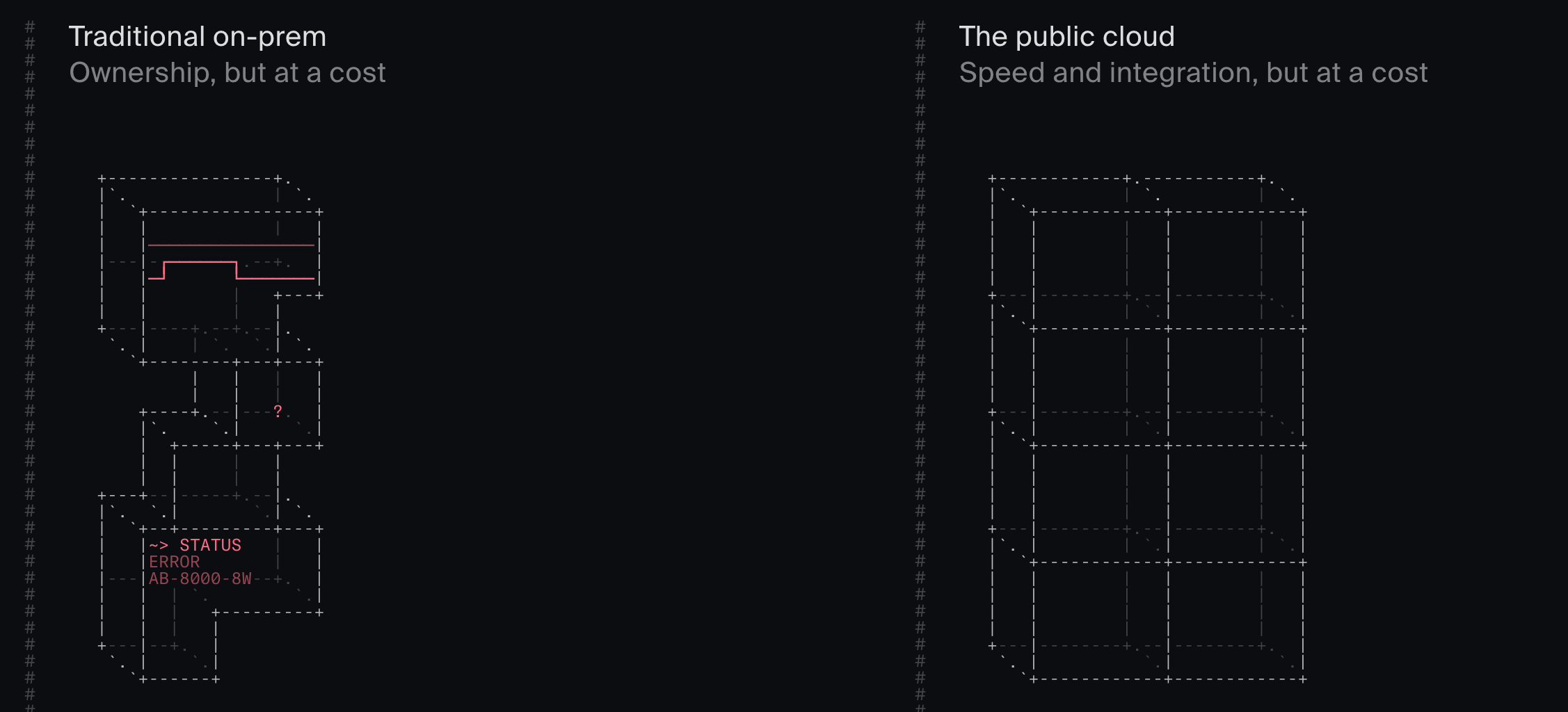
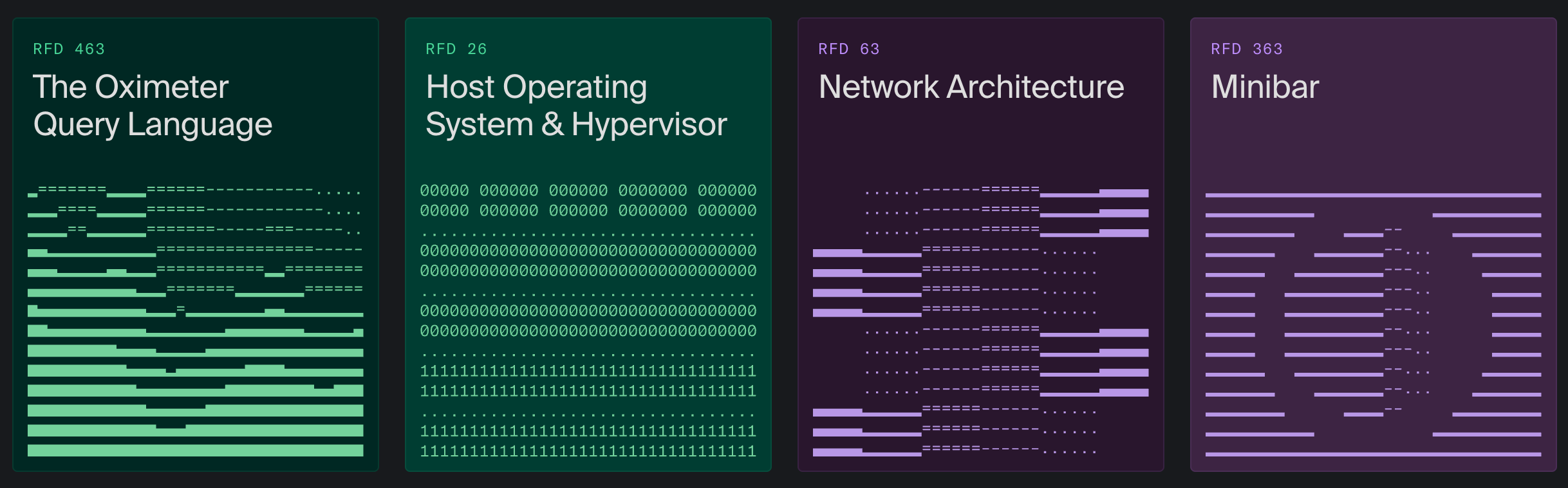
Where does that come from you may ask? I suspect it's Pentagram and Ben Leonard in particular who now works for Oxide. I came across his profile randomly when looking at ascii generators on github. They even have their own ascii tool: https://mitos.shared.oxide.computer/.
This proves a real design firm chose ASCII as a visual identity system for a serious company! (My second time referencing 0xide, first time was as an LLM writing reference in tropes.fyi, I like what they do tbh).
AISCII
If Claude and other models are so harshly trained on generating code surely they would be brilliant at generating ascii or at least generating code to generate ascii?
That's without even going into how much cheaper it is to generate text ASCII over images and videos! Each animation costs ~7,000 tokens to generate (skill context + reasoning + output) - fractions of a cent on Sonnet, a few cents on Opus.
So I started looking for libraries that would allow me to generate ascii animations, not converting existing videos to ascii but generative ASCII. A lot of patterns and generative art can be generated using mathematics so I wanted to see if there were any libraries that existed for ASCII.
I came across play.core. Here every character on screen is a cell. You write a function that takes a position and returns a character + a color. The runtime calls that function for every cell, every frame. So any pattern you can describe with math becomes an animation — waves, spirals, noise, whatever you can put into a formula.
Then my next step was how can I extend and improve this library to juice it with more functionality, more examples and most importantly serve it to Claude Code so I can use natural language to generate this art.
Another decision was should it be rendered on CC's native env the terminal or browser based, since these assets were to be used online then I thought, okay online better, better for sharing too.
All this culminated in aiscii, a browser-based ASCII animation runtime with a Claude Code skill that generates programs from natural language.
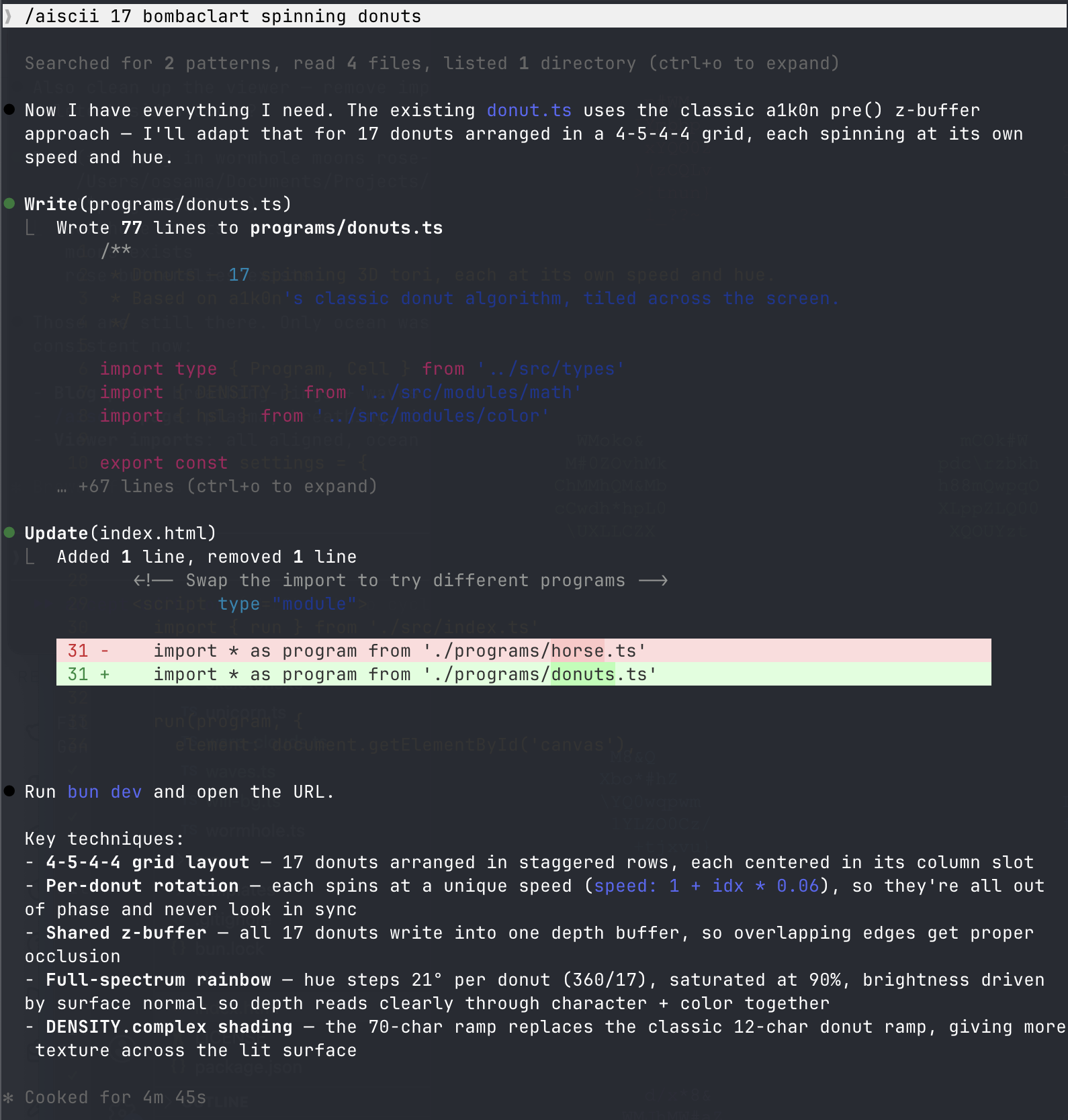
You type /aiscii a plasma field with neon colors and it writes a program, wires it up and tells you to refresh. The runtime is 12KB, zero dependencies, embeddable on any site.
Shortcomings
Ultimately, it fell short of what I actually wanted because there are two classes of animations:
Procedural (math works): plasma, breathing rings, ocean waves, noise fields. aiscii good.
Choreographed (math doesn't work): dancing skeletons, character animations, narrative sequences,
anything where a human would storyboard frames. This needs a frame-based approach. aiscii bad.
Claude was terrible at generating frames, utterly horrendous. These were the horses it generated. Wtf are those.
Here is Claude complaining that it sucks at generating ASCII art, potential legit model limitation:
"The ASCII art itself is bad. I drew those frames without being able to see them. I was guessing at what a horse looks like in 18x8 characters — and I guessed wrong. This is the fundamental challenge: I can't preview its own ASCII art. I'm writing characters blind and hoping they form a recognizable shape."
I found non-generative customisable ASCII playgrounds here (only after I built what I had):
Except these both render via WebGL.
Higher ceiling, but the characters are bitmaps not text.
aiscii renders real characters.
aiscii is open source if you want to play with it.
Future Work
It's easier to generate assets once you've developed a brand guide (most important part of any brand should include manifesto, colour scheme, moodboard, points of reference, inspiration, basically one big Figma board).
Given this you can go in any direction you want: WebGL, Three.js, GLSL, ASCII. etc.
I was inspired by things like Earendil's landing water scene, abstract particle fields, 3D logos with lighting. Claude can generate these from a prompt. The output of Three.js is rather high quality, runs in any browser, embeddable but very finicky and difficult to get started with, especially considering it doesn't have an official cli/mcp server so you'll be wrangling through the documentation yourself, but that's good you learn you learn.
The issue is it'll very likely be a different skill per scene type (water shader vs particle system vs 3D geometry), not a unified tool.
I think GLSL shaders is another viable option.
Claude is good at generating GLSL. You could build a skill that generates fragment shaders the way aiscii generates TypeScript programs. Higher visual quality ceiling than aiscii, same "natural language to live animation" workflow.
Ultimately, I may end up with a silly library of tool and skills each targeting a different rendering approach, all sharing the same "type a sentence -> get a live animation" interface.
Wait what clients or brand sites have you personally used this for?
17 bombaclart donuts.